A little clip of flying through the entrance to the Ruth Gorge a couple years ago. From about 1 minute onwards you can see the faces of Mt's Church, Grosvener, Johnson, Wake, Bradley and Dickey. These faces have had a lot of their plum lines picked in the last 10 years, but there are still some to go at. All around the 1000 metre mark, this part of Alaska is very much more on scale with the European Alps, rather than the huge lines on Denali, but still good fun!
Entering the Ruth Gorge from William Sim on Vimeo.
Thursday, July 28, 2011

Saturday, July 23, 2011
Photos and Movies
I think photos are super important. I have a very extensive photo gallery of everything i've ever climbed, from sport climbing to expeditions. By looking at my windows photo gallery i see that i have 3275 photos from 2011 alone, and theres another 5 months left! I'm also very lucky that my main alpine partner is an extremely good photographer, and therefore am guaranteed some gobsmacking photos nearly every time we go climbing.
I regularly find myself flicking through my photos and getting lost in the moment that the photo captures. I'll sometimes spend literally hours staring at my own photos remembering and pondering the moment they were taken.
"Tangibility" is an extremely crucial word when it comes to any sort of pleasure, and i think that in alpinism it is especially relevant, as its often not possible to enjoy the moment as it happens. Sometimes you may feel very scared and stressed, which isn't something that is naturally enjoyed at the time, but of course is fun to look back at. However, for me tangibility has more relevance when it comes to times of extreme beauty, which are frequent when alpine climbing, expecially in the greater ranges. I sometimes find (perhaps ashamedly) that natural beauty in its unique and rawest form can go slightly over my head. Of course i'm not saying that i don't appreciate it at the time, but its a bit like my brain exceeds its awe quota for that moment, and it therefore stuns me too much, and i can't take it in, forcing some of it to glide over my head. This is a real shame as these moments are rare, and when you find yourself seeing something that so few people, or sometimes noone has seen in the same way before, you want to receive an amount of pleasure in proportion to that. But maybe that's prusumptuous to expect.
Anyways, i guess what i'm saying is that photos can help you salvage a little of the awe you missed out on at the time, as well as confirming that yes, you were actually there.
A couple of years ago i got a Panasonic LX3, and since getting this camera i've been taking lots of movie footage. I also find myself watching clips over and over again reminding me of the moment. Although movie clips aren't quite so good for staring at and thinking, i find that because they're dynamic and often have a dialogue, i really enjoy showing them to my parents and other friends, as although you can say the same for photos, footage has a realness and interaction factor.
Here's a fun 360 i did from the summit of Cerro Standhardt last year.
Untitled from William Sim on Vimeo.
I've decided i'm going to upload some clips on to Vimeo from trips, and also just from big routes in the Alps. So have a little look through to see whats up already.
I regularly find myself flicking through my photos and getting lost in the moment that the photo captures. I'll sometimes spend literally hours staring at my own photos remembering and pondering the moment they were taken.
"Tangibility" is an extremely crucial word when it comes to any sort of pleasure, and i think that in alpinism it is especially relevant, as its often not possible to enjoy the moment as it happens. Sometimes you may feel very scared and stressed, which isn't something that is naturally enjoyed at the time, but of course is fun to look back at. However, for me tangibility has more relevance when it comes to times of extreme beauty, which are frequent when alpine climbing, expecially in the greater ranges. I sometimes find (perhaps ashamedly) that natural beauty in its unique and rawest form can go slightly over my head. Of course i'm not saying that i don't appreciate it at the time, but its a bit like my brain exceeds its awe quota for that moment, and it therefore stuns me too much, and i can't take it in, forcing some of it to glide over my head. This is a real shame as these moments are rare, and when you find yourself seeing something that so few people, or sometimes noone has seen in the same way before, you want to receive an amount of pleasure in proportion to that. But maybe that's prusumptuous to expect.
Anyways, i guess what i'm saying is that photos can help you salvage a little of the awe you missed out on at the time, as well as confirming that yes, you were actually there.
 |
| Soaking it up. |
 |
| Head to the ground, too fucked to soak anything up. |
 |
| A sleeping bag-less brew stop/bivi three quarters of the way up the buttress of the Moonflower. Not a particularly good photo but one of my favourites. |
A couple of years ago i got a Panasonic LX3, and since getting this camera i've been taking lots of movie footage. I also find myself watching clips over and over again reminding me of the moment. Although movie clips aren't quite so good for staring at and thinking, i find that because they're dynamic and often have a dialogue, i really enjoy showing them to my parents and other friends, as although you can say the same for photos, footage has a realness and interaction factor.
Here's a fun 360 i did from the summit of Cerro Standhardt last year.
Untitled from William Sim on Vimeo.
I've decided i'm going to upload some clips on to Vimeo from trips, and also just from big routes in the Alps. So have a little look through to see whats up already.
Thursday, July 14, 2011
Gates of Delirium
One of the great things about trad climbing in the UK, is how much reputation routes carry. "Gates of Delirium" has always been one of those routes for me. Firstly, its the name, how a name like that can be given to a pretty unatractive 3 pitch route through a chossy overhang, which anywhere else in the world wouldn't be given a second glance, just goes to show how much we have to make the most of our rock here in England. But i love it. That grandioso name makes it something fearful and brilliant, so does the completely over-the-top literature us Brits have to describe these (in the grand scheme of things) underwhelming routes we love so much. Any route which has an essay in Extreme Rock, and an old school photo of a wide eyed ascensionist gripped stupid on second is a route worthy of the utmost respect. Up there with Action Directe, the Infinite Spur and Latok's N. Face.
Then theres the brilliant grading. E4/5 6a/b. Hmmm so what does that mean?? i put a load of effort in for only an E4 tick?? its super sequency? a long reach? a crucial piece of kit? Ahh maybe i'll just climb something else.....
Previously this is what i've done, but yesterday, with very weary arms and thin skin from a hard session at the boulders the night before, Chris and myself thought what the hell, lets get it done. We bumped in to Malcolm and Pete in the car-park then made the short walk and loose scramble up to the base of the cave. There was a lively scene in the cave, Al Wilson and Mark Greenbank were strung on to Relayer, the E4 to the left, and Mr Birkett and wife Mary were doing battle with Blitzkreig to the right. "Its not been like this up here for 20 years!" Al enthused.
The main event "Gates" erupted from the back of the cave, vacant and waiting to be climbed. Excited, and eager to get going i jumped on to the first pitch. E1 climbing led to the "Hole" where i arranged the thread runners, before making the long horizontal traverse left, wild climbing blind and un-chalked had me pumped in no-time, i clipped the peg before realising it was useless, i fumbled in a small cam above my head, then fumbled the rope off the peg. Now really wishing i'd warmed up, i made the last 6a'ish move to bigger holds at the end of the traverse. "Fucking ****" signalled my departure from the rock, as did a jolt and "ping!" from the ripping cam.
A sunbstantial but safe winger, and 10 minutes of de-pumping exercises later, i was back making the moves again. This time not wasting energy on gear, but feeling the piercing gaze of Mr Birkett from his perch above and right on Blitzcreig. This time i reached the end of the traverse with ease and that "what the hell was i playing at the first time?!" thought. A smile exchanged with the eagle on Blitzcreig, led to the last balancy moves to my hanging belay. Chris dispatched the super technical Groove of the second pitch in good style, crimping it in to submission with his V10 strength.
Feeling tired from the combination of our mere three pitches of climbing and a severe bouldering hangover, we nipped up the classic E3 Empire then called it a day.
What a route, i hope my overly-descriptive account will contribute to the route's stature, and initimidation of any would-be ascencionists. Otherwise, we should bolt the lot....
Then theres the brilliant grading. E4/5 6a/b. Hmmm so what does that mean?? i put a load of effort in for only an E4 tick?? its super sequency? a long reach? a crucial piece of kit? Ahh maybe i'll just climb something else.....
Previously this is what i've done, but yesterday, with very weary arms and thin skin from a hard session at the boulders the night before, Chris and myself thought what the hell, lets get it done. We bumped in to Malcolm and Pete in the car-park then made the short walk and loose scramble up to the base of the cave. There was a lively scene in the cave, Al Wilson and Mark Greenbank were strung on to Relayer, the E4 to the left, and Mr Birkett and wife Mary were doing battle with Blitzkreig to the right. "Its not been like this up here for 20 years!" Al enthused.
The main event "Gates" erupted from the back of the cave, vacant and waiting to be climbed. Excited, and eager to get going i jumped on to the first pitch. E1 climbing led to the "Hole" where i arranged the thread runners, before making the long horizontal traverse left, wild climbing blind and un-chalked had me pumped in no-time, i clipped the peg before realising it was useless, i fumbled in a small cam above my head, then fumbled the rope off the peg. Now really wishing i'd warmed up, i made the last 6a'ish move to bigger holds at the end of the traverse. "Fucking ****" signalled my departure from the rock, as did a jolt and "ping!" from the ripping cam.
 |
| Following the first pitch through the roofs. From "Extreme Rock" |
A sunbstantial but safe winger, and 10 minutes of de-pumping exercises later, i was back making the moves again. This time not wasting energy on gear, but feeling the piercing gaze of Mr Birkett from his perch above and right on Blitzcreig. This time i reached the end of the traverse with ease and that "what the hell was i playing at the first time?!" thought. A smile exchanged with the eagle on Blitzcreig, led to the last balancy moves to my hanging belay. Chris dispatched the super technical Groove of the second pitch in good style, crimping it in to submission with his V10 strength.
 |
| The thin second pitch. |
Feeling tired from the combination of our mere three pitches of climbing and a severe bouldering hangover, we nipped up the classic E3 Empire then called it a day.
What a route, i hope my overly-descriptive account will contribute to the route's stature, and initimidation of any would-be ascencionists. Otherwise, we should bolt the lot....
 |
| Raven Crag, Thirlmere. The only crag in Cumbria to have been base jumped. |
Thursday, July 7, 2011
British Rock.
I've been in England since getting back from AK 3 weeks ago. Obviously super eager to get some strength back after life at 4500 metres and a winter of legs and lungs training, i've been getting out as much as i can between bits and bobs of work.
I find it really interesting how rock-strength works. I feel like my rock level has pretty much plateaued since i left school and discovered the alps. However, i still manage to exceed my previous summer's level without being any stronger every year. Why this is i really don't know. But i guess ultimately it shows just how big an affect cognotive and generally psychological workings have on rock climbing. That is until you're operating in the higher levels of sport climbing, when every gram, and micro-newton of strength each muscle fibre in your forearm has makes a huge difference.
The best example i can think of this, is when last year, after returning from Alaska and not rock climbing for possibly as long as 5 or 6 months, i cruised an E5 which for years i'd been putting off as the route had scared me silly. I remember standing at the top fresh, but confused as to what had just happened.
However, in contrast to last years experience, a week after returning from AK this year i got on the classic 7a+ of St.Bees, which at times i've been able to lap. I slumped on to the rope not even through the crux, with forearms feeling like they'd been injected with led . So i guess i'll just have to accept that going on two expeditions a year, and training for single-push alpinism is just not conducive to climbing 9a (or even 7a+....).
So here's some climbing over the last couple of weeks:
I had a couple of dampish days on Raven Langdale with Chris, and Kern Knotts with Pete. We climbed "R n S Special" and "Mussel Crack" at Raven. And a bunch of E1's in the wet at Kern Knotts.
I then went to Scotland with three friends for one of the best tradding weekends ever; 5 four star routes, all around 7 pitches or more, and all brilliant.
I find it really interesting how rock-strength works. I feel like my rock level has pretty much plateaued since i left school and discovered the alps. However, i still manage to exceed my previous summer's level without being any stronger every year. Why this is i really don't know. But i guess ultimately it shows just how big an affect cognotive and generally psychological workings have on rock climbing. That is until you're operating in the higher levels of sport climbing, when every gram, and micro-newton of strength each muscle fibre in your forearm has makes a huge difference.
The best example i can think of this, is when last year, after returning from Alaska and not rock climbing for possibly as long as 5 or 6 months, i cruised an E5 which for years i'd been putting off as the route had scared me silly. I remember standing at the top fresh, but confused as to what had just happened.
However, in contrast to last years experience, a week after returning from AK this year i got on the classic 7a+ of St.Bees, which at times i've been able to lap. I slumped on to the rope not even through the crux, with forearms feeling like they'd been injected with led . So i guess i'll just have to accept that going on two expeditions a year, and training for single-push alpinism is just not conducive to climbing 9a (or even 7a+....).
So here's some climbing over the last couple of weeks:
 |
| Nia pulling at the boulder paradise that is St Bees. |
I then went to Scotland with three friends for one of the best tradding weekends ever; 5 four star routes, all around 7 pitches or more, and all brilliant.
 |
| Looking down the wet Crux of "Shibboleth" E25c. |
 |
| Myself seconding pitch three. |
 |
| Great exposure on pitch 6. |
 |
| Two friends on pitch 7 after we'd topped out. We then went and climbed a combo of "Bludger's Revelations" and "Bloody Crack". |
 |
| It was really interesting for me to climb on the Buchaille for the first time. Like with many people, this mountain and Glen Coe, had a huge amount to do with me starting climbing. Driving through on the way north for family holidays as a kid, i'd have my face pressed against the car window, and willing my parents to drive as slowly as they could so i could watch the huge walls towering above. I remember once when i must have been about six or seven getting really upset and stamping around in tears in one of the laybys, as i wanted to go up the Buchaille. My mum and dad put their "foot" down, as it was lashing with rain and gusts were shaking the car. I just really really wanted to stand on the top. |
 |
| Glen Etive, a really nice place. |
 |
| "The Long Reach" E2 5b, without a doubt the best slab climb i've ever done in the UK by a million trillion miles. Reminds me a bit of "Motorhead" in Switzerland. We then Climbed "The Pause" which was also brilliant. |
 |
| There's lots of interesting stuff to be found at the base of Zero gully in Summer. |
 |
| Starting up the 10 pitch "Minus One Direct", the Walker Spur of the Ben! |
 |
| Tim seconding half way up. |
Thursday, June 30, 2011
Colin's blog.
Just off the mountain, Colin has written an excellent, summary of his and Nils' trip, and also a general summary of activities in the range this season. Check it out- http://www.colinhaley.blogspot.com/ . I especially like his suggestion of using the native Athabascan names for all the peaks in Alaska, like thats gonna catch on!!......
Sunday, June 12, 2011
AK 2011
I've just returned from a semi-successful trip to the Central Alaska range with Jon Griffith, and our Chamonix-based swedish friends Magnus Kastengren and Andreas Fransson, who had big skiing plans. Although we didn't manage to set foot on the main event, we had an awesome time with lots of friends and did some great climbing.
So firstly, a general synopsis: We arrived on the Kahiltna Glacier on the 8th of May. 5 days of good weather allowed us to get established at the 14,400ft (4400m) camp, this took 4 days, double carrying on the last day, between the 11000 and 14000 camp. We then set to work gently acclimatising by making regular forays up to 17000 feet via the west buttress, the "rescue couloir" and the west rib cut-off. We then had enforced inactivity for about 5 days due to poor weather, 2 of these days were spent tent-bound. Afer this weather passed we made an ascent of Denali via the west buttress, by-passing the 17000ft camp and making it to the summit from 14000 in 6 hours. We then climbed the upper west rib to the football field. The final component of our acclimatisation was an ascent of the Cassin ridge. We climbed the route in a single push (14 hours 40 minutes) then descended down to the 14000ft camp.
At this point we felt ready to launch on to our main objective, but we needed the weather. After a few rest days we decided to descend to base camp in poor weather. From here we could launch on to our objective on the South face of Denali, or if a window not large enough appeared we could try our back-up plan on Foraker. Unfortunately the weather steadily deteriorated from this point, with one low pressure after another rolling over the range. After a talk with Mark Westman who was watching weather charts from his home in Talkeetna, we made the decision to get out of the range as the weather was nowhere near stable enough to try anything and to wait much longer would jeopardise catching our flight out of Anchorage later in the week.
 |
| Last minute packing and sorting before getting on the plane. This is usually done under a state of apprehension and excitement, and therefore stuff is usually overseen and forgotten! |
 |
| Packing the Plane in Talkeetna. A DeHavilland turbine Otter. |
 |
| Foraker, Hunter and Denali getting closer. |
 |
| Unpacking on the aistrip at Kahiltna base camp. We spent one night here then shot off up the mountain the next morning. |
 |
| After a medium sized day of sledge hauling, we pitched our bivi tent at 9800ft, slept, woke up and carried on. The west buttress of Denali as far as the 14000ft camp can be likened to a typical three day ski tour in the European Alps. By that i mean similar distances and height gain per day, but obviously you're gaining actual height every day with no descent, carrying a very heavy sledge and you're not having red wine induced sleep in cosy huts! From 14 to the summit, its like doing the Three Monts route on Mont Blanc 1 and a half times, (but feels much much harder due to greater altitude). Its the done thing to sleep at 17000 to split this day in half but if you're fit its not neccessary. The west buttress makes a perfect route to acclimatise on. |
 |
| Another day was spent to make 11000ft. From here we made another carry of half our stuff up to 14000ft, then returned to sleep at 11000. We then made one final carry, moving all our stuff up to 14000ft. So altogether that's 4 days to get everything, including ourselves, to 14. It could be done in 3, but as we had so much time to spend acclimatising at 14, we thought we may as well go slow. |
 |
| Windy Corner. |
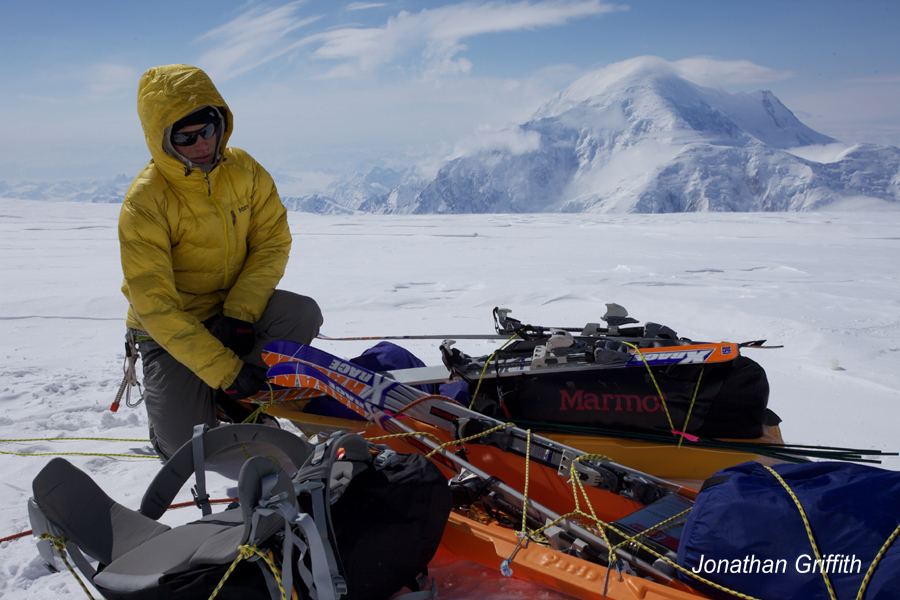 |
| Unpacking at 14000ft. We managed to ski 80% of the way from the Kahiltna airstrip to 14 camp. But our little skins and skis couldn't cope with the weight of the sledges on the steeper, icy hills. Hence the skis on sledge. |
 |
| Once established at 14, we set about acclimatising on the upper mountain. The 14 camp is at 4400 metres (much more understandable for us europeans). It feels a little higher due to Denali's latitude, so kinda like living on the summit of Mont Blanc. To acclimatise well to 5 and 6000 metres we made many short forays above the 14 camp, on the west buttress and west rib areas. We also skied a bit. |
 |
| Jon on the West Rib. |
 |
| Magnus going for a ski off the West Rib cut-off. |
 |
| Chilling with the wizard of 14 camp, Greg Collins. Greg could recount perfectly the crux moves of Cockblock, Ressurection, Strapadictomy, Poetry Pink and more, from when he climbed them in 1987, on his way back from Latok. |
 |
| We had a good scene at 14 on rest days, with several good friends from all around the world, who i see regularly in Cham and elsewhere, and of course Magnus and Andreas. |
 |
| The team. Jon Griffith, myself, Nils Nielson, Andreas Fransson, Colin Haley and Magnus Kastengren. |
 |
| Crossing a crevasse on the "Autobahn" while acclimatising on the West Buttress. |
 |
| Tent time. There was one particularly bad period at 14. We didn't go out of the tent much for a few days. |
 |
| Once this weather cleared, we climbed to the summit via the West Buttress. 6 hours from 14 to the top exactly. Magnus and Andreas also summited that day via the West Buttress. Whilst we were up there Andreas dropped in to the south face, solo. A descent of the south face, via the "Haston-Scott" was Andreas' big plan for the trip. We all thought he'd come back when more acclimatised but unbelievably he felt ok and went for it. Hands down the most audacious thing i've ever witnessed in the mountains. |
 |
| We all spent a nervous day and night waiting for news from Andreas, as he didn't check in on his radio as planned that night. Skiing the south face is a big deal, its been the holy grail of Alaskan skiing for 30 years with much talk but barely a handful of attempts. We knew he was capable of it, Andreas is one of the best in his field of extreme skiing in the world, but there were a huge amount of unknown factors involved. Thankfully he turned up in Basecamp about 20 hours after he had dropped in, making history with his first descent of the South face of Denali! In this photo he's recovering after regaining the 14000ft camp. |
 |
| For further acclimatisation purposes, Magnus Jon and myself then made an ascent of the upper West Rib to the football field. |
 |
| Myself and Magnus on the top of the upper West Rib. |
 |
| Reaching the football field. |
 |
| As the final component of our acclimatisation we decided to climb the Cassin ridge. We wanted to climb it in a single push and estimated it would take around 20 hours. The "normal" ascent time for this uber-classic testpiece is around 3-4 days. So we went super light and committed ourselves. We took a freeze dried meal each, one small gas canister and jet boil, a duvet jacket, 2 man bothy sack, and a 30 metre rope. This photo shows Jon melting some snow so we could start fresh on the Japanese couloir. |
 |
| I suffer from the confusing problem of very warm hands and feet. I made a good effort to dry out my sweat-drenched feet after descending the Seattle ramp, and before the brutally cold Alaskan night set in. We crossed the schrund at about 8.30pm. |
 |
| Jon in the Japanese couloir. Home to some very grey ice and some old fixed ropes. Hence why we roped up for this little section as the brittle ice was shattering all over the second climber. |
 |
| On the Knife-edge/"Cowboy" arete at about 10.30pm. We didn't take any photos for the 5 hours after this, as it was simply far too cold to stop and fiddle with cameras. |
|
| About 3 or 4 a.m. after all the technical stuff. Lungs hurting from lack of oxygen, legs hurting from the 2000metres that lay behind us. |
 |
| After all the technical stuff, with over 1000 metres still to go, we bundled in to the bothy sack. Unfortunately we found out at this point that the jet boil was broken. Instead of lots of warm water and a meal each, we ate a couple of Gu's and sipped the little unfrozen water we had (this triggered my gag reflex badly and i was sick, but had been feeling altitude sick for a while and felt better afterwards). We got going again after about 20 minutes. |
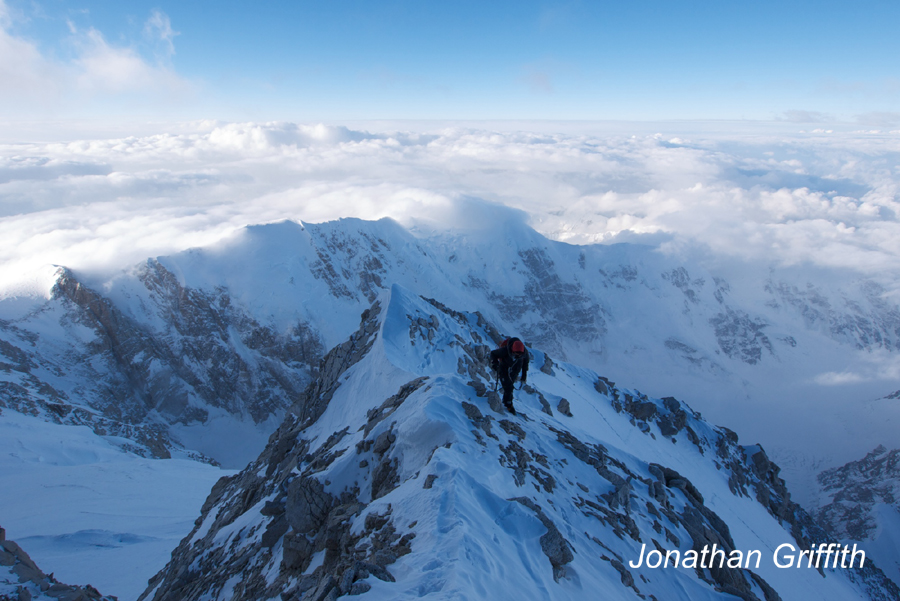 |
| On the ridge of the upper Cassin. |
 |
| Not far from the top. It suddenly became very windy on the top 600 metres. A large plume of spindrift and cloud trailed for a km or so off the summit and we started to dread topping out.... |
 |
| Jon on the final 300metres. To avoid the windy right hand arete and blizzard that appeared to be on top, we climbed a long way over on the left, before realising it was a bad idea and then traversing back and up on to Kahiltna horn. This was a stupid error caused by altitude and tiredness, which cost us time. |
 |
| 14.40 after starting we top out on to Kahiltna Horn. It was a beautiful day, the winds had calmed to maybe 20-30mph, and the big plume of nastyness had dissapeared. We made it back to 14000 camp in about 3-4 hours, after a short stop at the 17000 camp to chat with some friends and chill out in their tent. In the 22 hours roundtrip we had climbed over 3000 metres/9500ft including the approach-big day! |
Feeling the strain after Cassin single-push. from William Sim on
Vimeo.
After our ascent of the Cassin, we spent a day or two recovering. We were both pretty knackered, but more annoyingly i had some frostnipped toes. I've never suffered badly from cold injuries in the past as i'm really lucky and have good circulation. The night was cold on the Cassin, probably about -25, but normally this would have been ok. However, with the combination of very wet feet from the approach down the Seattle ramp and about 1 litre to drink on the whole route, (i'd normally hope to drink about 5), i think my feet were just much more susceptible.
This was however more of an annoyance rather than a stopping factor. We made the decision to relocate to the airstrip from where we could base ourselves for the main event, a different line on the south face. The weather through this period was one low pressure after another. Warm and wet, with snow falling lightly from 14000 and below. After a couple of days we began to realise that if the forecast was remotely right for the next week, we didn't have the time to do our south face objective and make our flight out of Anchorage on the 13th of June. We couldn't miss this flight as Jon had to be at his sister's wedding on the 15th.
After the time window we required had become unattainable, we transfered our psyche on to our objective on Foraker. For me, and i think i speak for Jon also, this was the most unpleasant part of the trip. We spent day after day worshipping the latest weather forecast and thinking hard about what Foraker would be like. I hated not knowing what we'd be doing in the immediate future. While this was the case higher up on Denali, it was bearable as it was early in the trip, and everything was gearing towards acclimatisation and just hanging out high up.
After a chat with Mark Westman over sat phone, who was studying weather charts from his place in Talkeetna, we made the decision to pack up and get on the list of climbers (some of which had been waiting 6 days to fly due to weather) waiting for a plane. The weather was forecast to continue with back to back lows with one day of nice weather in the next week. Marks interpretation of the weather charts backed this up, which made it a relatively pain-free decision in the end.
We made it out of the range that afternoon in a Beaver ski plane with just minutes to spare. Our pilot had just informed us that he may have to do an about turn back to the airstrip, when a cloud thinned just enough for him to see the other side of a pass, and then out we went, in to the beautiful green wilderness that stretches between the mountains and Talkeetna. A minute later we heard Lisa at basecamp shut down all air traffic as the weather worsened.
Although we both had that lingering unsatisfied feeling in our hearts, we were both excited about burgers, showers and the drunken mayhem that was about to commence!
 |
| That night in the Fairview was probably the best so far. All the stress of whether we were going to get our climb done or not went out of the window and we danced hard till at least 5a.m.. Andreas and Magnus, also chuffed to be out. |
 |
| Magnus getting to know the locals. |
 |
| Chilling by the Susitna river, looking back at the mountain we'd spent the last month on. |
 |
| After two manic nights in Talkeetna we got a bus to Anchorage. We still had 2 days to wait for our flight. But some very kind people we met last year put us up on their living room floor and gave us lots of stuff to do. One day we borrowed a car and a couple of bikes then went for an interesting ski mission on Ptarmigan peak in the Chugach mountains just outside Anchorage. After a short bike ride then a steep boot-track we were rewarded with 600 metres of spring conditions in a couloir up to 45 degrees. Thanks Bryan for the hospitality!! |
 |
| Making turns in our approach skis. A fun end to a fun trip! |
The Cassin, the record and etc.'s
As has been reported on various websites, we climbed the Cassin 20 minutes faster than the previous speed record. We had not intended to do this and we didn't even realise we had when we topped out, (we were unsure of the exact record). The record was Mugs Stump in 1991, 15 hours bottom to top, and 27.30 from 14 back to 14. Our times were 14.40 bottom to top and 22 hours round trip from 14. The specifics of each ascent vary a bit: From what i understand Mugs had a track the majority of the way up the route. We had a track as far as the first rockband (first thirdish??) thanks to Andreas and Magnus who made a two day ascent on either side of our ascent. Mugs approached by skiing and downclimbing the west rib. Jon and myself approached by downclimbing the Seattle ramp. I think the Seattle ramp is the faster of the approaches if you get it right (was excellent condition for us). However, on skis Mugs may have made it pretty fast, sadly he's not around anymore to ask. For Jon and myself it was our first time on the south face, but i have a feeling (could be wrong??) that Mugs had climbed the Cassin once before. All these changeable factors are what make the 20 mins improvement seem to me even less significant!
I don't know a great deal about history of other fast ascents of this route. From speaking to people who know their Alaskan climbing history, i believe it has been single pushed a handful of times, or maybe less. The only real attempt to beat the record that i know of was last year by Colin Haley and Bjorn Eivind Artun, who made it from the bottom to the summit of Denali (Stump and Jon and myself didn't do the final stroll to the true summit) in 17 hours something. I think Colin and Bjorn Eivind had a hard time of it with conditions. And i expect Colin and Nils Nielson will smash the record in the next week or so.
Anyways, just thought i'd put the record straight. (no pun intended, seriously....)
Subscribe to:
Posts (Atom)